The Moon
From the reading made for my own chart, as it was written. "You" here is me. Yours would be written from your chart.
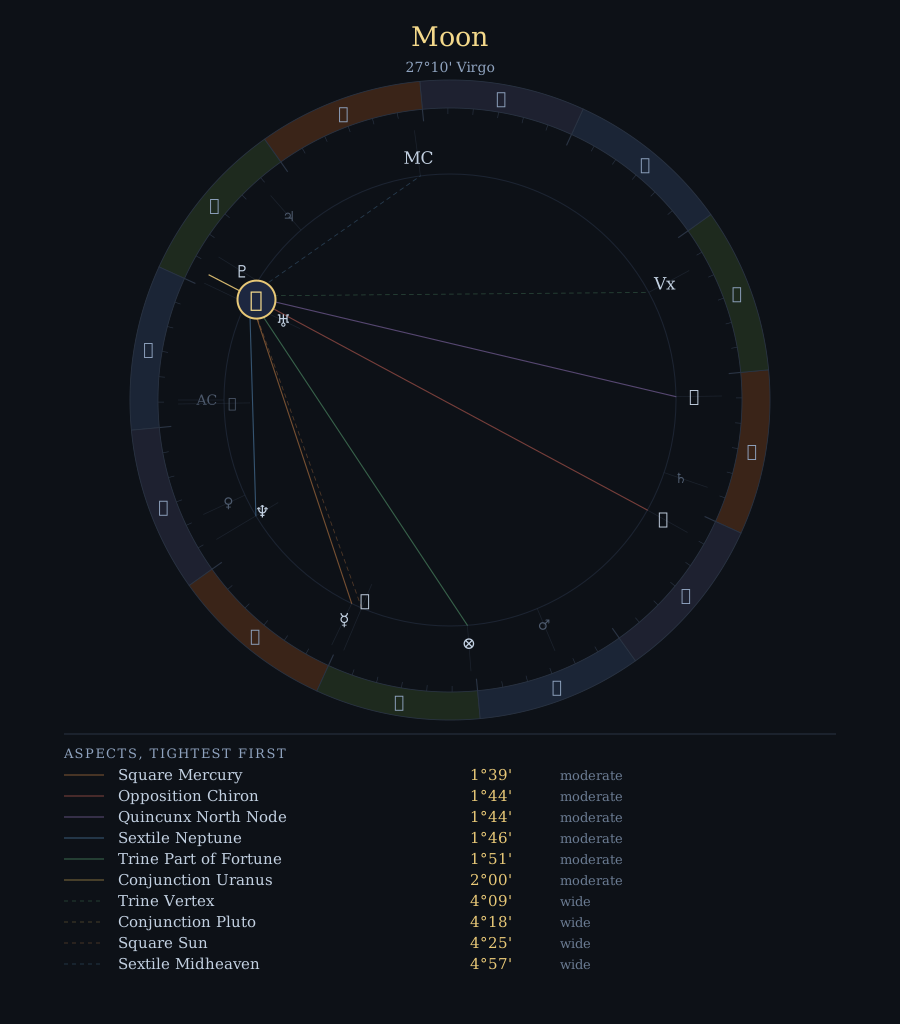
27°10’ Virgo · above the horizon, on the rising side · leads the chart as the light of a night birth · in a sign that neither helps nor hinders it · ruled by Mercury
Square Mercury 1°39’ · Opposition Chiron 1°44’ · a T-square with Mercury and Chiron
What Moon in Virgo means, and what your own chart does with it.
The Moon in Virgo
Emotional Nature
Moon in Virgo processes emotions through analysis. When a feeling arrives, the first response is not to express it or even to fully feel it but to understand it: to identify its cause, assess its legitimacy, and determine what action would be appropriate. The emotional experience passes through an analytical filter before it is accepted as valid. This creates a relationship to feelings that is careful, considered, and often more restrained than the actual emotional depth.
The emotional rhythm is steady, controlled, and attuned to the body. Virgo is mutable earth: the feeling state is responsive to physical conditions: diet, sleep, health, and environmental order. The Virgo Moon’s moods are more connected to physical wellbeing than to emotional events. A bad night’s sleep will produce more emotional disturbance than a difficult conversation, because the body is the primary emotional register.
The emotional default when unstressed is quiet alertness: a background awareness of what needs attention, what is slightly wrong, and what could be improved. This is not anxiety (though it can become anxiety); it is the emotional system operating as a quality-control mechanism. The Virgo Moon is emotionally most comfortable when everything in the immediate environment is functioning properly.
Sensitivity operates through discernment. The Virgo Moon perceives fine details: the micro-expression that reveals discomfort, the slight disorganisation that signals someone is struggling, the physical symptom that indicates a deeper problem. This is not empathic absorption (as with water Moons) but precise observation. The emotional intelligence is expressed through noticing what others miss.
Emotional expression is restrained and often channelled into action rather than words. Rather than saying “I’m worried about you,” the Virgo Moon tidies, cooks, offers practical help, or points out a health concern. The feeling is real; the expression is oblique.
Nurturing and Comfort
The Virgo Moon nurtures through practical service: through fixing what is broken, organising what is chaotic, and attending to the details that others overlook. When someone is struggling, the Virgo Moon’s instinct is not to hold them but to help them: prepare a meal, research a solution, make an appointment, sort out the practical logistics that are compounding the emotional difficulty. This is genuine care, expressed through the language of usefulness.
What provides comfort: order, routine, cleanliness, the feeling of having been useful, a well-functioning body, and the experience of a problem being solved. The Virgo Moon self-soothes through organising, cleaning, exercise, health-related activity, and any task that produces visible improvement in the immediate environment.
What is needed from others when distressed: practical help, patience, and the acknowledgment that the feelings are legitimate even if they seem disproportionate to the cause. The Virgo Moon is often distressed by things that others consider minor: a messy environment, a body that is not functioning well, a process that is inefficient, because these are genuine emotional triggers, not trivial complaints.
The nurturing challenge is the tendency to help when what is needed is presence. Not every emotional situation requires a practical solution. Learning to sit with someone’s pain without trying to fix it: to offer the comfort of being rather than the comfort of doing: is the central growth edge.
Intuition and the Subconscious
Intuition in Virgo Moon operates as pattern analysis: the rapid, often unconscious assessment of data that produces a conclusion before conscious reasoning catches up. The Virgo Moon “knows” something is wrong because it has observed a hundred small details that, individually, mean nothing but collectively indicate a problem. This is a form of intuition that is highly reliable but does not feel intuitive. It feels like careful observation.
The subconscious is orderly and procedural. The inner world is organised by category: problems to be solved, patterns to be understood, things that need fixing. Dreams often involve work, lists, or the experience of trying to get something right. The Virgo Moon’s subconscious does not rest; it continues processing, organising, and troubleshooting during sleep.
The relationship to the subconscious is cautious. The Virgo Moon is not comfortable with the irrational, the chaotic, or the uncontrollable aspects of the inner world. Feelings that do not make sense: emotions that have no identifiable cause, moods that cannot be traced to physical or circumstantial factors: produce anxiety rather than curiosity.
The growth area is developing comfort with the irrational: learning that not all emotional experiences can be analysed into understanding, and that some of the most important inner material arrives in forms that resist categorisation.
Imagination and Inner Creativity
The inner creative life of Moon in Virgo is detailed, methodical, and oriented toward refinement rather than generation. The imagination works best in revision mode: taking something that exists and making it better, cleaner, more functional. The creative impulse is editorial: the satisfaction of taking a rough draft and perfecting it, of solving a design problem through precise adjustment, of making something work that previously did not.
The private imaginative life often revolves around idealised order: the perfect system, the perfectly healthy body, the perfectly organised environment. These visions fuel productive creativity when they are treated as directions rather than requirements. When they become rigid standards, they produce the characteristic Virgo Moon anxiety of never being good enough.
Creative nourishment comes from the experience of craft: the pleasure of skilled hands working on detailed problems, the satisfaction of incremental improvement, the beauty of precision.
Habits and Emotional Patterns
The dominant habitual pattern is worry: a low-grade, persistent anxiety about whether things are good enough, healthy enough, organised enough, or correct enough. This is the emotional system’s quality-control function running continuously, and it can consume significant emotional energy even when nothing is actually wrong. The worry is not about catastrophe (that is more Scorpio or Capricorn); it is about imperfection.
Comfort habits centre on control of the immediate environment: cleaning, organising, health-related behaviours, list-making, and any activity that reduces the feeling of chaos. Under stress, the Virgo Moon tightens control: the routines become more rigid, the standards more exacting, the tolerance for disorder more fragile.
The recurring emotional cycle is: perception of imperfection → anxiety → attempt to fix → temporary relief → perception of new imperfection. The cycle is self-perpetuating because the Virgo Moon’s perceptual system is designed to find what is wrong, and there is always something wrong.
The childhood pattern often involves having learned that emotional safety comes through being good: being helpful, being quiet, being useful, not making trouble, not having needs that inconvenience others. The child who earned love through service carries this pattern into adult relationships, where being needed becomes the primary attachment strategy.
Home, Family, and Roots
Home for the Virgo Moon is the well-maintained environment: clean, ordered, functional, and health-supporting. The emotional relationship to the home is through its condition: when the house is clean, the Virgo Moon is calm. When it is disordered, emotional agitation follows regardless of other circumstances. This is not obsessive-compulsive behaviour (usually); it is the genuine emotional connection between environmental order and inner peace.
The emotional atmosphere of the childhood home was often characterised by standards: either high standards that were consistently maintained (producing the expectation of order) or standards that were inconsistently applied (producing anxiety about when things might fall apart). There may have been a premium on being helpful, on not being a burden, on contributing to the household’s function.
Family bonds operate through service and practical support. The Virgo Moon maintains family relationships by being useful: the one who remembers medications, who organises family events, who notices when someone is unwell. The emotional investment is expressed through attention to detail rather than emotional declaration.
The Parent Who Comforted
Traditionally read as the mother. The role may have been held by a father, a grandparent, someone else entirely, or by nobody at all: what matters is who provided early comfort, or failed to.
The archetypal mother experience for Moon in Virgo often involves a maternal figure who was practical, health-conscious, critical, or anxious. The mother may have been experienced as a corrective force: someone who noticed what was wrong before noticing what was right, whose love was expressed through attention to the child’s health, hygiene, behaviour, and achievement rather than through emotional warmth.
What was learned about care is that it operates through service and correctness. That being good, being clean, being useful, and not causing problems is the way to secure love. What may not have been learned is that emotional needs are valid in their own right. That the child did not need to be useful to deserve care.
The internalised mother voice is critical: a running commentary on what could be done better, what should have been avoided, and what is wrong with the current state of things. This voice is both the Virgo Moon’s greatest asset (driving the pursuit of excellence) and its greatest burden (preventing the experience of being good enough).
The developmental task is separating the helpful inner editor from the punitive inner critic: keeping the capacity for discernment while releasing the assumption that love is conditional on perfection.
Tensions and Growth Edges
Self-criticism as emotional default. The analytical mind turns inward as a habit, producing a running assessment of personal inadequacy that masquerades as self-awareness. The growth edge is developing genuine self-compassion, not the absence of standards but the recognition that being human includes being imperfect.
Worry as pseudo-control. When the world feels uncertain, the Virgo Moon worries, not because worrying helps but because it provides the illusion of being prepared. The growth edge is recognising that worry is not preparation and that the emotional energy spent on anticipated problems is unavailable for actual ones.
Service as avoidance of emotional intimacy. Helping can become a way of staying emotionally safe: providing care without receiving it, being useful without being vulnerable. The growth edge is developing the capacity to be present in relationships without a task to perform.
Perfectionism as paralysis. The standard is so high that beginning anything carries the risk of falling short. The growth edge is learning that starting imperfectly is more valuable than waiting for perfection, and that the refinement process (which is a genuine strength) cannot begin until something imperfect exists.
What your chart adds
You were born at night, and in a night birth it’s the Moon, not the Sun, that leads the chart. The Moon here is your first response: the feeling reaction that arrives before you’ve had time to think, and the things you need in order to feel settled. Everyone born in the same couple of days has the Moon in Virgo, but its place at the head of your chart, and the two connections described below, are yours. It works on the right shift, the hours it was made for, and Virgo neither helps nor hinders it, so the sign describes how it works without tipping the scale either way. That gives the Emotional Nature above more weight than a single trait would carry. The quiet alertness to what’s slightly wrong, the quality controller running in the background, tends to be the first thing in you to move, and a good deal of the rest of your chart takes its cue from it.
Your Moon sits above the horizon, in the part of the sky that stands for the self out in the world, and it’s the only one of your personal planets up there. Most of what you think, want and build happens out of view, so the part of you that others see first is your reaction. What Emotional Nature says about restrained, oblique expression may well hold for your words, but your face and manner tend to be less discreet. The people around you can often see a judgement forming before you’ve noticed you’ve made one: a small change of expression at a plan, a glance at the thing that’s out of place, a pause before you say something kind.
Recognition. People have asked you what’s wrong, or told you that you plainly don’t like something, at a moment when you hadn’t yet realised you’d reacted at all, and when you thought about it afterwards they were usually right.
Virgo is Mercury’s sign, so your Moon answers to Mercury, the planet of thinking and speech. In your chart Mercury is in Sagittarius, a sign where it isn’t native and has to be built rather than given, and it’s working the wrong shift for a night birth. Mercury in turn answers to Jupiter, which sits in Virgo in the same position, not native and on the wrong shift, and Jupiter answers back to Mercury. The authority your feelings report to is two short-handed parts lending each other what neither has, with nothing settled at the end of the line. That bends The Parent Who Comforted and the first of the Tensions and Growth Edges: the inner voice that checks your feelings reports to a check that is never quite finished itself, so the assessment tends to go round rather than conclude. The same loop sits behind the way your work gets improved rather than finished, which the Jupiter chapter describes.
Your Moon also shares Virgo with Jupiter, Uranus and Pluto. Uranus and Pluto stayed in that sign for years and belong to everyone born across that stretch, and Jupiter stayed for months, while the Moon passes through in a couple of days. It’s the member of that group that is yours, and it’s through your Moon that the sign’s habit of noticing and correcting reaches the most personal part of you.
Your closest connections
The closest of these, the square to your Mercury, holds at least this close for only about 7 hours of births.
Mercury, square (1°39’)
Mercury sits a quarter of the way round the sky from your Moon, which is called a square, a connection that works as a steady friction between two parts of you. Because Mercury is also the planet your Moon answers to, the part meant to make sense of your feelings meets them at an awkward angle. In Sagittarius, your thinking voice reaches for the broad conclusion rather than the fine detail, and it says what it thinks plainly. So a feeling of yours doesn’t tend to stay a feeling for long. It’s handed almost at once to a judgement about what it means and what should be done, and the judgement is usually quick, general and sure of itself. That movement, from a feeling to a firm conclusion in a moment, is the fast verdict, and this is where it starts. Mercury is also tightly bound to Uranus, so the verdict tends to arrive all at once rather than building. The Uranus chapter describes where that suddenness shows.
This bends Nurturing and Comfort most. The wish to help rather than simply hold is there, as the section describes, but in you it tends to arrive as a diagnosis: what went wrong, what the other person might do next, what you could sort out for them, often within a minute and before anyone has asked. It bends Intuition and the Subconscious as well. The reading of patterns is real, but where a Virgo Moon on its own would gather the hundred small details, yours can jump from the first few to the whole picture, and the conclusion can run ahead of the evidence for it.
The cost falls first on the people closest to you. They can come to experience being cared for as being assessed, and many of them will have learned to expect the fix before the comfort. You tend to do the same to your own feelings, and more harshly. A feeling of yours isn’t allowed to stand until it has been checked for whether it’s reasonable, and while it’s being checked it’s hard to stay in it long enough to find out what it actually is.
Recognition. When someone close to you is upset, your first move, usually within a minute or so, is to work out what’s wrong and suggest what to do about it, before you’ve asked what they want from you. At least one person has told you, in some form, that they didn’t need a solution and only wanted you to listen.
Recognition. Asked how you feel about something that has upset you, you’re more likely to explain whether your reaction is fair, or what caused it, than to name the feeling itself, and you can dismiss a feeling as unreasonable before you’ve let yourself have it.
Chiron, opposition (1°44’)
Chiron sits directly across the sky from your Moon, which is called an opposition: two parts of you facing each other from opposite sides, so that you tend to live one of them and meet the other in the people around you. Chiron in Pisces is where other people’s distress gets in, the kind of unhappiness that has no clear shape or cause. Your Moon is the side that sorts and repairs, and what faces it is the one sort of trouble that can’t be sorted. When you meet that shapeless distress in someone else, your first response does what it knows how to do, and goes looking for the cause and a way to fix it.
Emotional Nature says this Moon works through precise observation rather than soaking up other people’s feelings the way a water-sign Moon would. In your chart that’s only half the picture. The observation is yours, and so is a pull from the opposite side toward other people’s unhappiness, which arrives without any of the edges your Moon needs in order to work with it. That bends Intuition and the Subconscious too, because some of the feelings that don’t make sense, the ones that section describes as unsettling, can belong to someone else. What that distress does to you afterwards is described in the Chiron chapter.
Both ends of this opposition also meet your Mercury at right angles, so the pull between sorting and shapelessness is handed to your thinking voice to settle, and it tends to settle it the way it settles most things, quickly and broadly, by naming a cause. This shape is a T-square, formed here by your Moon, Chiron and Mercury, and that’s the name to look up if you want to read more.
Recognition. When someone close to you is low and can’t say why, you find it harder to be with them than when there’s a clear problem, and you’re likely to keep offering possible causes and remedies after they’ve made it plain that they only wanted company.
How tightly it’s connected
| Connection | How far from exact | Band | How common, measured across 100,000 charts |
|---|---|---|---|
| Mercury, square | 1°39’ | standard | about 1 chart in 43 has this pair within 2° |
| Chiron, opposition | 1°44’ | standard | about 1 chart in 90 has this pair within 2° |
Your Moon also sits close to Uranus, Pluto, Neptune, the North Node and several other points, but each of those follows from the two connections above, so none of them is counted again.
Both counted connections fall within about two degrees, which leaves your Moon firmly connected without being tightly bound: neither pair is close enough to run everything, and both are close enough to be felt on most days. Between them they bend Nurturing and Comfort hardest, turning help into diagnosis, and Intuition and the Subconscious next, where reading a pattern becomes a quick conclusion and shapeless feeling becomes something to fix. What they leave largely alone is the steadiness Emotional Nature describes, the link between your mood and order, sleep and the body, which in your chart is the sign’s own contribution and is shared with everyone born in those two days.
Each figure in the table describes one pair on its own, measured by how often that pair falls this close across a hundred thousand charts cast at random. The connections within a single chart lean on one another, so the figures can’t be multiplied together into one number for the whole chart.
Practices
Imperfection tolerance. Leave one area of the home deliberately imperfect for a week. Notice the emotional response. Let it exist. This builds the capacity to tolerate disorder without emotional collapse.
Emotional naming before acting. When the impulse to help, fix, or organise arises, pause and name the feeling underneath. Am I anxious? Am I trying to earn love? Am I avoiding a feeling of my own? Then choose whether to act.
Body-based feeling. When an emotion arrives, feel it in the body before analysing it. Where does it live? What temperature is it? What does it want? Let the body hold the feeling for thirty seconds before the mind intervenes.
Receiving practice. When help or care is offered, accept it without reciprocating, qualifying, or assessing its quality. Let someone take care of you on their terms, not yours.
Worry containment. Designate ten minutes per day as “worry time.” During those minutes, worry fully. Outside those minutes, redirect the mind. This prevents the background hum of anxiety from consuming the entire day.
Self-compassion practice. When the inner critic delivers its assessment, add one sentence: “and that is human.” Not to excuse, but to contextualise. The standard remains; the punishment is removed.
Pleasure without purpose. Weekly engagement in a sensory pleasure chosen entirely for enjoyment, not health, not self-improvement, not utility. A meal chosen for taste. A walk chosen for beauty. This reconnects the body to pleasure that is not earned through correctness.
Of these, Emotional naming before acting fits your chart most closely, because the pause it asks for falls in exactly the minute when the fix tends to arrive. Body-based feeling fits for a related reason: it asks for the thing the fast verdict takes away, a little time inside a feeling before your mind steps in to judge it, and you might find the feeling turns out to be something other than you’d assumed. Receiving practice may be worth trying too, since care that comes towards you tends to be assessed as quickly as the care you give. The practices built around worry and tidiness describe the sign more than your particular chart, and you’ll know better than anyone whether they apply.